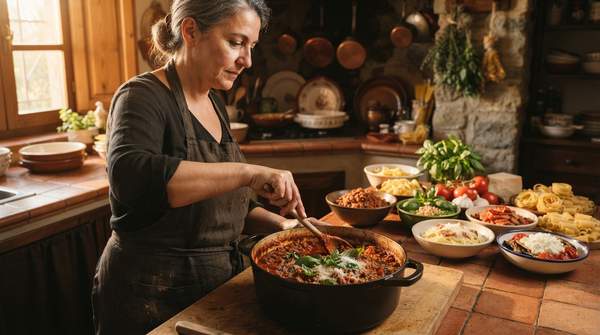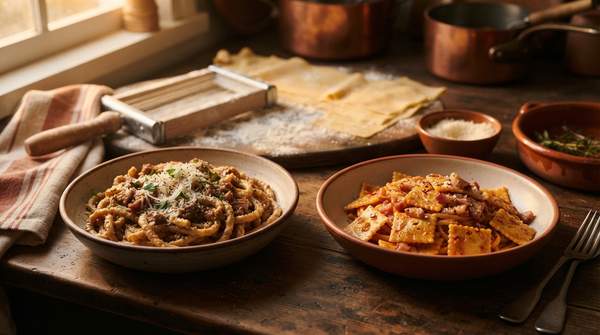
Regional Italian pasta shapes are not accidents of local habit; they are functional designs. Each shape's thickness, surface texture, and geometry were developed to solve a specific culinary problem: how to carry a particular local sauce from the plate to the fork. Two lesser-known examples make this logic visible. Bigoli, the thick, rough noodle of Veneto, grips a silky anchovy and onion sauce that would slide off smoother strands. Pasta alla chitarra, the square-edged noodle of Abruzzo, captures hearty lamb and tomato ragùs that round spaghetti would shed.
The Culinary Logic of Pasta and Sauce Pairings
Traditional pasta-sauce pairings across Italy's regions can be understood as a kind of culinary engineering. The reasoning follows a consistent pattern: a pasta's physical properties determine what kind of sauce it can effectively deliver, and a region's typical sauce, in turn, rewards a specific pasta design.
The first variable is surface texture. A rough or porous exterior gives a sauce something to grip, which matters most when the sauce is slippery or oily. The second is geometry. A strand's cross-section—round, square, tubular, or flat—changes both its surface area and the firmness of its bite. The third is the sauce itself: its consistency, its ingredient size, and how it behaves on a hot, wet noodle. According to culinary tour writer Eleonora Baldwin, who documented these regional traditions, bigoli's rough surface specifically exists so that slippery sauces can cling to it, while pasta alla chitarra's squared edges hold sauces better than round spaghetti. Those are two different mechanical solutions to the same pairing problem.
This framework is deliberately narrow. It covers two illustrative regional shapes in detail rather than cataloguing every variety, and it explains principles rather than providing complete recipes. Common globally known shapes like spaghetti and penne sit outside its scope, because the clearest lessons come from shapes whose design purpose is unusually legible.