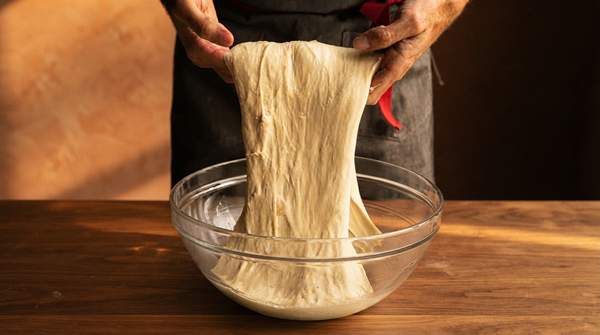
Gluten is the protein network that gives bread its structure, and a baker who understands how it forms can deliberately steer a loaf toward chewy or tender. The mechanism is straightforward: when wheat flour meets water, two proteins—glutenin and gliadin—hydrate and bind into a continuous web of strands, and mechanical work then aligns and reinforces that web. Every lever you can pull, from flour protein content to kneading time, hydration, fat, and resting, either strengthens or weakens this network. This guide explains the science and turns it into a decision framework you can apply to any wheat-flour dough.
The Science of Gluten: Building Blocks of Bread Texture
Gluten is a protein found in wheat products, and in bread making it does the structural heavy lifting. Modernist Cuisine's team describes it as the net that holds bread together: it traps the gas bubbles produced during fermentation so the dough can rise, and it gives bread its characteristic texture. Without a sufficiently developed network, expanding gas simply escapes and the loaf stays dense.
When flour is mixed with water, the gluten proteins swell and form a continuous network of fine strands, as the grain-industry resource Bake Info explains. That network is what makes dough both elastic—able to spring back—and extensible—able to stretch. The texture of the finished loaf is largely a readout of how strong, how well-developed, and how appropriately balanced that network was at each stage, which is why the same four ingredients can produce anything from a chewy bagel crumb to a tender sandwich loaf.
Gliadin and Glutenin: The Proteins Behind the Network
Two proteins with opposite temperaments build the network. Glutenin molecules are long, and once hydrated they link to one another through disulfide bonds to form strong, stretchy units—interlinked strands that Modernist Cuisine notes are among the largest protein molecules yet identified. Glutenin is the strength and elasticity of dough, the reason a well-developed loaf can hold its shape against the pressure of expanding gas.
Gliadin, by contrast, is compact and mobile. It allows the dough to flow like a fluid, contributing extensibility and plasticity rather than raw strength. The two work as a team: glutenin supplies the elastic backbone, gliadin supplies the give. This balance is dynamic and can be manipulated by the baker—more developed glutenin character yields chew and spring, while a relatively softer, gliadin-forward, underdeveloped network yields tenderness. Neither protein is "better"; the target depends entirely on the bread you want.
Hydration and Mechanical Work: Developing the Gluten Network
Water is the trigger. The moment flour is hydrated, glutenin and gliadin proteins begin to bind and form gluten, and the network swells into continuous strands. But hydration alone is slow and uneven, and this is where mixing earns its place. As Modernist Cuisine points out, mixing is essential not because kneading is strictly required to develop gluten—gluten will form with minimal mixing over time—but because agitation speeds hydration and disperses water evenly through the flour.
Mechanical work also restructures the network itself. The stress of mixing breaks bonds between protein chains, allowing the chains to move and realign, and new bonds then form that let the dough relax, as Bake Info describes. Research summarized in a scientific review of gluten in food products found that sufficient mixing increases ionic and hydrogen bonds in the gluten, while the sulfhydryl groups of the protein are oxidized into disulfide bonds during mixing, stabilizing the network. The same review, citing work by Jia and colleagues, adds the crucial caveat: excessive mixing exposes more free thiols, degrading the network. In other words, kneading strengthens gluten up to a point, and past that point it begins to destroy it—and the exact point of degradation varies with flour type and hydration.
Controlling Bread Texture: A Baker's Decision Framework
Because each factor below pushes the gluten network in a known direction, texture becomes a set of choices rather than a recipe's accident. The framework maps a desired outcome—chewy or tender—to the specific adjustments that produce it, and pairs each factor with the observable indicator that tells you whether you have achieved it.
| Controlling Factor | How It Acts on Gluten | For Chewier Bread | For Tender Bread | Key Indicator |
|---|---|---|---|---|
| Flour protein content | Higher protein means more gluten can form; bread bakers generally target 11%–13% protein for good volume and texture | Choose a higher-protein bread flour | Choose a lower-protein flour | Protein percentage on the flour label |
| Kneading / mixing | Aligns protein strands and forms stabilizing bonds; excessive mixing degrades the network | Knead to full development | Mix only until ingredients are combined, as pastry dough is | Dough smooths and becomes elastic; windowpane test |
| Hydration (water) | Water hydrates gliadin and glutenin so they can bind; even dispersion speeds formation | Ensure full, even hydration | Keep mixing brief so hydration stays minimal and uneven | No dry flour pockets; dough cohesive |
| Fat content | Fats coat the proteins and prevent gluten development | Limit added fat | Add fat to shorten and tenderize | Dough feels softer, less springy |
| Resting / fermentation | Resting relaxes elasticity and lets strands align; over-proofing weakens structure | Proof fully but stop before the structure fails | Rest the dough to reduce elasticity before shaping | Dough relaxes and expands without deflating |
Read the table as a menu: to make a loaf chewier, strengthen the network with higher-protein flour, fuller kneading, and full hydration; to make it tender, weaken the network with lower protein, minimal mixing, added fat, and generous resting. The Institute of Food Science and Technology's educational resource notes that mixing, flour type, water amount, and the presence of fats are all among the factors affecting gluten formation—so a chewy-versus-tender decision is rarely one change, but a coordinated set of them.
Beyond Kneading: The Role of Fats and Fermentation
Fats are the baker's shortcut to tenderness. They work physically, by creating a coating around the proteins that prevents gluten development—which is the principle behind shortening and, more broadly, why pastry dough is mixed only until ingredients combine. The IFST resource adds a useful boundary from the other side: if there is too little gluten in a pastry dough, it falls apart easily. Tenderness has a floor.
Fermentation interacts with gluten over time. Resting relaxes the dough and reduces its elasticity, which is why a rested dough rolls out more easily. But the clock cuts both ways: when carbon dioxide exerts more pressure than a proofed dough can withstand, the gluten structure weakens, releasing the gas and deflating the over-proofed dough, as Modernist Cuisine explains. Time also works slowly on the proteins themselves—protease enzymes naturally present in small amounts in wheat flour snip gluten strands into smaller pieces that can make additional connections, though an excess of protease would cut the strands too much and weaken the network instead.
Mastering Your Dough: Intentional Baking for Desired Results
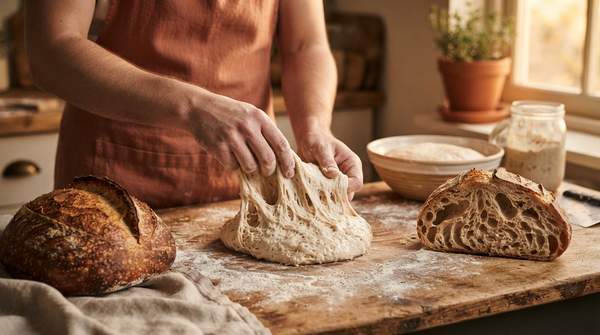
Bakers can intentionally control bread texture by understanding and manipulating gluten development through hydration, kneading, flour choice, and other ingredients. The practical test of that control is the windowpane test: take a small piece of dough and stretch it thin. A properly developed dough stretches into a thin, translucent sheet without tearing, because the aligned glutenin and gliadin strands are strong enough and extensible enough to hold together. A dough that tears instead is underdeveloped and needs more work or more time.
Use the framework diagnostically as well as prospectively. If a loaf came out tougher and chewier than intended, look back at protein content, kneading length, and fat; if it collapsed or tore, check whether the dough was over-proofed or under-kneaded. The measurable indicator of success is the ability to consistently achieve your desired texture—chewy or tender—and to pass the windowpane test at the appropriate stage of dough development. When you can predict the crumb from the choices you made at mixing, you are no longer following a recipe; you are directing the chemistry.
Sources
- Gluten: How Does It Work? - Modernist Cuisine
- What role does gluten play in bread making? - Bake Info
- The Role of Gluten in Food Products and Dietary Restriction — PMC
- Protein: gluten formation — Institute of Food Science and Technology