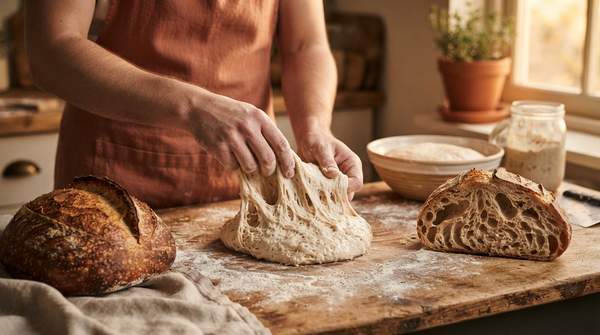
Hydration—the water in your dough expressed as a percentage of your flour weight—is the variable that most directly shapes how your sourdough handles, ferments, and bakes. Most bread doughs fall between 60% and 80% hydration, and where you land within that band determines whether you get a dense, chewy crumb or a custardy interior shot through with irregular holes. But higher is not automatically better: Maurizio of The Perfect Loaf, who has documented doughs across the range, reports having seen beautifully open crumbs at 68% hydration and a tight crumb at 80%. The right number depends on your skill with sticky dough, your flour, and the loaf you actually want.
Understanding Sourdough Hydration: The Basics
Hydration follows the baker's percentage convention: total water divided by total flour, multiplied by 100. When Mariusz Lasak tested 76% hydration at Flourwise, that meant 760 grams of water for every 1,000 grams of flour. The same arithmetic works at any scale, which is why bakers scale recipes by flour weight rather than by volume measures that shift with every scoop.
One correction matters before you trust any recipe's stated number: the water in your levain counts toward total hydration. A reader's comment on The Perfect Loaf's calculation example points out that omitting the levain leaves the true hydration higher than intended. As an illustration of the method, imagine 500 grams of flour, 325 grams of added water, and a 100-gram levain maintained at 100% hydration—meaning it contains 50 grams each of flour and water. Your real dough is then 375 grams of water to 550 grams of flour, or roughly 68% hydration, not the 65% the flour-and-water figures alone would suggest.
Hydration, however, is only one factor in crumb structure. Proper fermentation, good shaping technique, and appropriate baking all play crucial roles, as The Perfect Loaf emphasizes; pushing water higher cannot substitute for mastering those fundamentals.
The Impact of Flour Type and Environment on Hydration
Dr. Vanessa Kimbell, who writes for The Sourdough School Magazine after more than forty years of baking, tells her students to treat a recipe's water quantity as a guide, not an absolute. In her framing, the variability of flour protein, fibre, and age all impact the final result, and no two flours are the same. Different flours absorb water differently depending on their protein content, how finely they are milled, and even the climate where the grain was grown—factors that determine how much water the flour can handle and how much you should add during mixing.
That is why The Perfect Loaf insists there is no ideal hydration in the abstract: it depends on the flour you are using and the bread characteristics you are after. Every bag of flour is slightly different, and every day in your kitchen is slightly different. The skill that closes that gap is what Maurizio calls baker's intuition—learning to see and feel what your dough is telling you rather than rigidly following numbers.
Water also changes the clock. Kate Freebairn of The Pantry Mama notes that an increased amount of water will cause sourdough to ferment more quickly, which matters if you want a shorter bulk fermentation; her advice is to adjust the amount of starter so the dough does not race past readiness. Her practical rule for experimentation applies equally to water: make small increases rather than leaping from 70% to 85% and losing the ability to shape the dough when the time comes.
Sourdough Hydration Levels: Characteristics and Handling
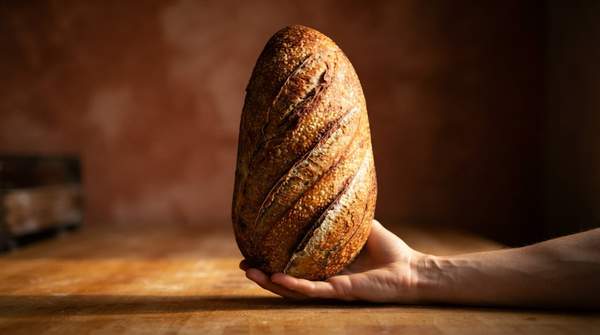
At the low end, around 60–65%, dough is stiff and easy to handle, requiring less folding, and it produces a dense crumb with a thick, chewy crust—the territory of bagels, pretzels, pizza, and some pan loaves. Move to 65–70% and the dough becomes balanced and manageable with good structure, yielding a nice open crumb and a crisp crust; this is where The Perfect Loaf points beginners, recommending a start around 68–70% with a quality bread flour for a forgiving dough that still produces a beautiful loaf.
The 70–75% band is the sweet spot for many artisan loaves, suited to classic country breads and baguettes. The dough is pliable and shapes more easily than wetter mixes, but it still requires careful gluten development. Flourwise frames 70–72% as the level for bakers who have successfully baked ten or more loaves at lower hydration, want classic artisan appearance and texture, are comfortable with stretch-and-fold technique, and are ready to handle slightly sticky dough in exchange for better oven spring.
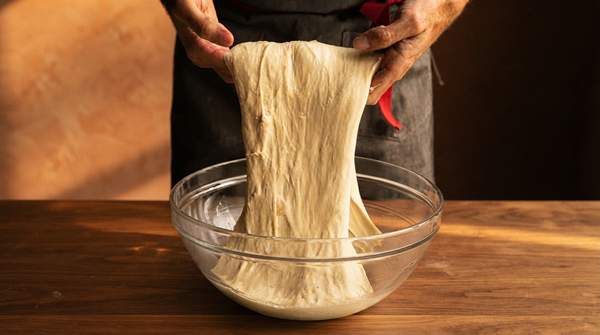
From 75–78%, the demands sharpen: the dough is very sticky and extensible, needs five or six sets of stretch-and-folds for adequate structure, and requires confident, gentle handling at every stage. The reward is a very open crumb with large irregular holes and spectacular oven spring, but timing becomes critical—the window between perfect and over-proofed narrows. Beyond 80%, doughs are reserved for specific breads like focaccia or ciabatta, and The Perfect Loaf warns of the failure mode at the extreme: too much water and the dough becomes a soupy mess that cannot hold its shape. Across the whole spectrum, high-hydration loaves trend toward a thinner, crispier crust—brittle, with a custardy interior—while lower hydration gives a substantial crust and chewy texture.
Sourdough Hydration Decision Framework
The table below compares the reported outcomes and handling requirements across the hydration spectrum so you can match a target percentage to your skill level and the loaf you are aiming for. The characteristics are typical results reported by the bakers cited above; flour type and fermentation can still shift them in either direction.
| Hydration | Best for | Dough handling | Expected crumb & crust | Typical styles |
|---|---|---|---|---|
| 60–65% | Beginners; stiff, cooperative dough | Stiff and easy to handle; needs less folding | Dense crumb; thick, chewy crust | Bagels, pretzels, pizza, some pan loaves |
| 65–70% | Beginner sourdough; recommended start of 68–70% | Balanced and manageable, with good structure | Nice open crumb; crisp crust | Everyday classic breads |
| 70–75% | Bakers comfortable with stretch-and-folds; classic artisan goals | Pliable and easier to shape than wetter doughs; needs careful gluten development | Classic artisan texture; better oven spring than lower levels | Country loaves, baguettes |
| 75–78% | Experienced bakers seeking maximum airiness | Very sticky and extensible; 5–6 sets of stretch-and-folds; gentle, confident handling; narrow proofing window | Very open crumb with large irregular holes; spectacular oven spring | Showcase open-crumb loaves |
| 80%+ | Reserved for specific styles; risk of dough that cannot hold its shape | Very fluid; demands precision and experience | Brittle crust with a custardy interior, as reported for high-hydration loaves | Focaccia, ciabatta |
Reading the table as a progression, the handling techniques and effort required increase with each step up the hydration scale, and the payoff shifts from reliability toward airiness. Flourwise's recommended ladder makes the comparison concrete: bake eight to ten loaves at 65% to master fundamentals, spend twelve to fifteen loaves at 70–72% to develop wet-dough technique, try 75–78% only after twenty-five or more successful loaves if you want a more open crumb, and reserve 80%+ for focaccia or ciabatta. Documenting each bake with notes on dough feel, timing, and results is part of the method, because your perfect hydration depends on your flour, technique, and preferences.
Mastering Hydration for Your Perfect Loaf
Bakers should intentionally choose their sourdough hydration level based on their desired crumb and crust, their comfort with dough handling, and the specific flour characteristics. This guide covers one variable within wheat-based sourdough under standard home baking conditions—it is not a complete recipe, and professional bakery environments may demand different considerations.
Choose your target from the framework above, calculate your true hydration including levain water, and adjust by feel when your flour asks for it. The measurable indicator of success is this: the baker observes consistent dough handling and achieves predictable crumb and crust results aligned with their chosen hydration percentage. When several consecutive loaves at the same target behave the same way in your hands and emerge with the crumb and crust you selected, you have mastered that level—and only then is it time to step up the scale.
Sources
- What Is Dough Hydration? (And How to Get It Right) — The Perfect Loaf
- Sourdough Hydration Chart: 65-80% Crumb Results — Flourwise
- Hydration The Sourdough School Magazine by Dr Vanessa Kimbell
- Sourdough Hydration for Beginners — The Pantry Mama