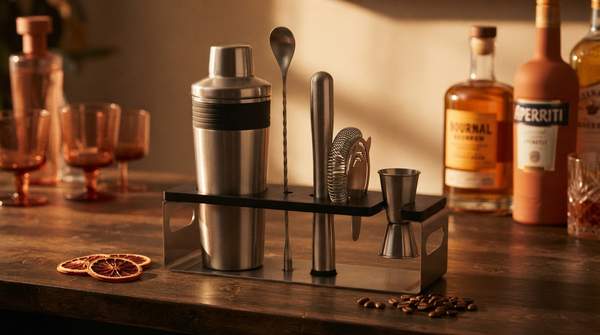
You do not need a fortune—or a cabinet full of gadgets—to make great cocktails at home. Alex Day and David Kaplan, co-authors of Death & Co: Modern Classic Cocktails, told Wirecutter that "you can spend an absolute fortune on any bar tool, but by and large, it's not necessary." The consensus across the sources here points to a compact core: a cocktail shaker, a jigger, a strainer, and a bar spoon. Buy those four individually rather than as a kit, and you can shake or stir nearly any classic recipe.
The Cocktail Shaker: Your Mixing Workhorse
The shaker is the foundation of the whole setup. As Eight Oaks Farm Distillery's Amanda Koehler explains, a shaker "lets you properly chill, dilute, and combine ingredients, ensuring a smooth and well-balanced cocktail." It is the tool that turns cold ingredients into a properly cold drink, and no other piece of equipment substitutes for it.
Shakers come in three main varieties. The Boston shaker is a two-piece design—a metal tin paired with a glass or a second metal tin—and Koehler notes it is "preferred by professionals for its capacity and efficiency." The Cobbler shaker is a three-piece design with a built-in strainer and cap, which she describes as "more user-friendly for beginners." A third option, the French shaker, is a two-piece metal shaker similar to the Boston but with a sleeker design and no glass component.
Material matters as much as form. Glass shakers demand caution: as one SKYCORPS essay on shaker materials observes, owners of glass "naturally become more cautious," gripping tighter and thinking twice before tapping the tin on a counter. Stainless steel, by contrast, "doesn't warp, rust, or crack under pressure," letting you focus on the cocktail rather than the tool. A stainless steel manufacturer's industry overview goes further, calling stainless steel the professional standard, "favored by bars, hotels, and chain restaurants worldwide," and the most cost-effective material in the long run.
Boston vs. Cobbler: Choosing Your First Shaker
Because the shaker is your most important purchase, the Boston-versus-Cobbler question deserves its own decision. The two designs trade convenience against versatility, and the right answer depends on what you want from your first few months behind the bar.
| Attribute | Cobbler Shaker | Boston Shaker |
|---|---|---|
| Ease of use | Three-piece design with built-in strainer and cap; more user-friendly for beginners, though it can be harder to open when cold. | Two-piece tin-and-glass design; sealing and opening take practice, but professionals favor it for its balance and efficiency once mastered. |
| Versatility | Fixed built-in strainer and smaller capacity limit flexibility across cocktail types. | Handles larger batches and works with separate straining methods, making it more adaptable to varied recipes. |
| Durability (material) | Available in glass or metal; glass versions require more caution to avoid breakage. | Stainless steel tins resist warping, rust, and cracking, and are the dominant professional choice. |
| Professional preference | Seen as beginner-friendly or home-oriented; ease of use trades off against professional speed and flexibility. | Considered a standard tool in professional bar settings for its capacity and efficiency. |
The framework resolves cleanly. If your priority is simplicity—open the box, add ice, shake, and pour through the built-in strainer—the Cobbler is the confident first purchase. If you would rather learn the professional technique from day one and gain room for larger batches and varied straining methods, the Boston shaker rewards the steeper learning curve. Either way, choose stainless steel over glass for durability, unless the visual appeal of a glass tin is worth the extra care it demands.
The Other Three Essentials
The jigger is your measuring tool, and Wirecutter's testing team pairs it directly with the shaker as the starting basics for anyone getting into cocktails. Precise measurement is what separates a balanced drink from a disappointing one, and a jigger makes it repeatable rather than guesswork.
The strainer matters most if you choose a Boston shaker, since the two-piece design has no built-in filtering. Its general role is separating ice and solid ingredients from the finished drink as you pour; a Cobbler's integrated strainer covers the same job inside the shaker itself, which is one reason beginners often find it friendlier.
The bar spoon rounds out the set for stirred drinks—those built in a glass rather than shaken. It is the tool that lets you chill and dilute gently without the aeration of shaking, the technique behind classics like the Old Fashioned that New Deal Bottle Shop's staff highlight among their home-bar favorites.
Why Individual Tools Beat the All-in-One Kit
The temptation for beginners is the bundled kit, but Wirecutter's guidance is to buy individual pieces rather than sets, because the quality per tool tends to be higher and you avoid paying for implements you will rarely use. The same logic applies to the shaker itself: a single well-made stainless steel tin outlasts a cheap multi-piece set, and the manufacturer's overview frames stainless steel as the most cost-effective choice over time precisely because it survives professional-grade use.
There is also a scope discipline worth naming. This guide covers only the four tools that mix the drink. Glassware, ice tools, and garnishing equipment are real categories, but none of them gates your first cocktail the way these four do, and none of them needs to be in the first purchase.
Your First Step to Crafting Classic Cocktails
Begin your home bar setup by acquiring a high-quality cocktail shaker—Boston if you want professional versatility, Cobbler if you want simplicity—along with a jigger, a strainer, and a bar spoon, purchased individually for better quality and value. The measurable indicator of success is the ability to consistently prepare a variety of classic shaken and stirred cocktails with proper chilling and dilution. When your Margarita arrives frosty and your stirred Old Fashioned arrives silky—every time, not by accident—you will know the four-tool core is doing its job.
Sources
- The Best Barware for Making Cocktails at Home — Wirecutter: Reviews for the Real World
- Essential Bar Tools for Crafting the Perfect Cocktail at Home — Eight Oaks Farm Distillery
- Should I buy a glass or metal cocktail shaker? — SKYCORPS
- Are Metal or Glass Cocktail Shakers Better? — best cocktail shaker stainless steel, boston shaker boston stainless steel, cocktail shaker set, stainless steel cocktail shaker set, target stainless steel cocktail shaker set
- Essential Bar Tools for the Home Bar — New Deal Bottle Shop