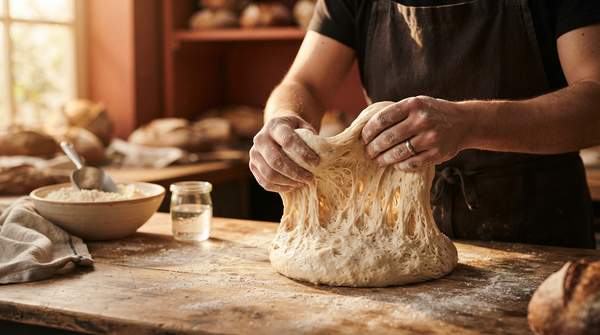
Here's the short version: the texture of your bake—chewy or tender—comes down to how much gluten you develop, and you control that with two levers. First, your flour choice, because protein content sets the ceiling on gluten formation. Second, your technique, because mixing and kneading decide how close you get to that ceiling. Master both, and you can steer any recipe toward the texture you're after.
The Science of Gluten: Foundation of Baked Goods
Gluten forms when two proteins in wheat flour—glutenin and gliadin—meet water and get agitated. As Rossi Anastopoulo explains in King Arthur Baking's beginner's guide, glutenin gives dough elasticity, so it snaps back like a rubber band, while gliadin contributes extensibility, meaning the dough can be stretched. Those sound like opposites, but a good dough needs both.
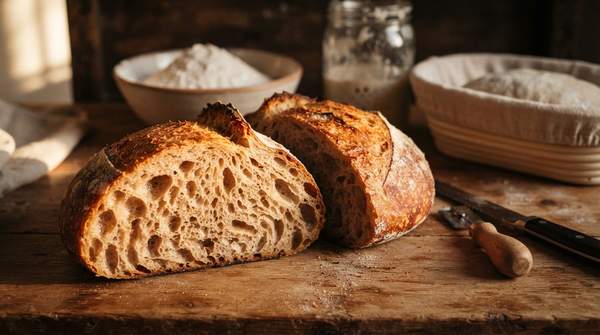
Why does this matter for your bake? That network of strands traps gas bubbles. The stronger the web, the more gas it holds, which means more air and a higher rise. But there's a trade-off: as Anastopoulo notes, the more gluten develops, the longer and stronger those strands become, "which leads to more chewiness and toughness in the final product."
So gluten isn't good or bad—it's a dial. For breads, you want serious dough strength to create chew and trap gas. For cakes and other tender bakes, you want the opposite. The whole game is controlling how far development goes.