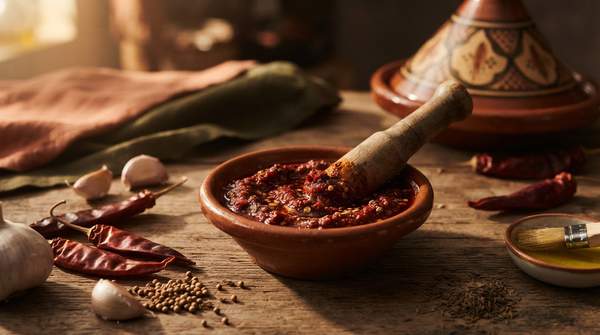
Harissa is a hot chili pepper paste that belongs, first and foremost, to Tunisia. It's built on roasted red peppers and the Baklouti pepper, seasoned with garlic, caraway, coriander, cumin, and olive oil — and in 2022, UNESCO inscribed harissa's knowledge, skills, and culinary and social practices on its Representative List of Intangible Cultural Heritage. Once you know that baseline, the variations you'll see on shelves — Tunisian, Moroccan, and rose harissa — become much easier to tell apart, and much easier to cook with.
The Tunisian Roots of Harissa
Chili peppers aren't native to North Africa. They arrived through the Columbian exchange, and Wikipedia's entry on harissa traces the paste's origin to that importation, presumably during the Spanish occupation of Hafsid Tunisia between 1535 and 1574. That's a remarkably specific window, and it tells you something: harissa was born of a collision of trade routes, not invented in isolation.
The condiment's heartland is the Cape Bon Peninsula, the birthplace of the pepper-growing tradition, with Nabeul famous as the primary center of production. Munya, writing at Our Tunisian Table, puts the cultural claim bluntly: "If there is one ingredient that is quintessentially Tunisian, it has to be harissa." She adds that harissa is a Tunisian condiment despite the way it's typically marketed in the United States.
That marketing tension is real. The food seller Zwïta, which writes extensively about harissa's Tunisian identity, devotes an entire piece to questioning what "Moroccan harissa" even is — while stressing it's not about gatekeeping, but about accuracy. Harissa is most closely associated with Tunisia, Morocco, Algeria, and Libya, as the specialty retailer Sous Chef notes, but it is most deeply rooted in Tunisian cuisine, where it's sometimes described as the national condiment.